Round vs Rectangle Dining Table: Which Is Better? (October 2026)
Choose a round table for easy conversation and a compact shared area; choose a rectangle table for a longer room and more defined seating. Your space, chair placement and usual guest count should decide the shape.
On this page (6 sections)
A round dining table suits conversation and an open shared area; a rectangle suits a longer room and more defined seating. For a round vs rectangle dining table, compare the full footprint with chairs pulled out, then consider how many people you usually seat.
A round top has no corners to bump into when you move around it. A rectangle gives each diner a clear place along its sides and can fit more naturally against a long wall or in a narrow dining zone.
The examples below show how the shape choice plays out across a fixed round table, a long rectangle and a table that expands from round to oval.
 Best for shared conversation
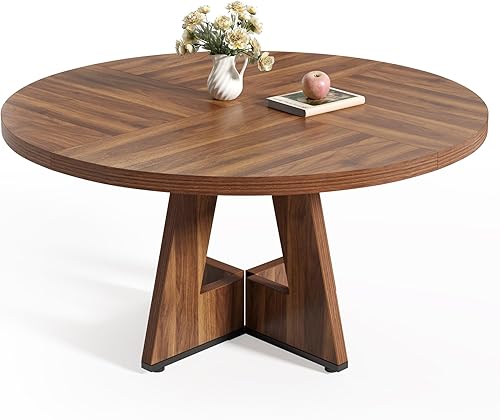
LITTLE TREE 47 Inch Round Pedestal Dining Table
 Best for a long dining area
Farmhouse Rectangle Dining Table for 6, Oak
Round vs rectangle dining table: which shape fits your room?
Choose the shape that leaves usable space around the table after chairs are in place. The tabletop alone doesn't show how much room you need to walk, sit down and stand up.
A round table uses a circular footprint, so the distance from its center to the edge stays the same in every direction. A rectangle has a longer axis and a shorter one, which can make it easier to align with a long room.
These models make that difference clear. The LITTLE TREE is 47.24 inches in diameter, while the BERRY NEST rectangle is about 70.08 inches long and 30.71 inches deep.
The measurements describe the table, not the space required around it. Add room for pulled-out chairs and the paths people use to pass through the dining area.
Is a round table better for a small space?
A round table can be easier to navigate around because it has no corners, but it isn't always the better fit. Its diameter may use more width than a narrow rectangular table.
Check whether the room is nearly square or long and narrow. In a square area, a round top can feel centered; in a narrow one, a rectangle may follow the room's length with less unused space.
Our guide to whether a round table is better for small spaces walks through the same trade-off. Mark the tabletop and chair positions on the floor before you decide.
When does a rectangle make better use of the room?
A rectangle often fits a dining area that runs beside a kitchen or along a wall. Its long sides can line up with the room, while the ends remain available for chairs when the layout allows.
That orientation can also help define a dining zone in an open-plan room. Leave enough space at the ends for people to sit down and walk around.
A long table can still feel crowded if chairs block a doorway or appliance. Try a floor outline first, including the room's main path.
How do the shapes affect seating and conversation?
Round tables bring diners into a shared circle; rectangles create seating along the sides and ends. Neither shape guarantees comfortable seating, since the chairs and base matter too.
The LITTLE TREE round table is described for 4–6 diners. Its pedestal base keeps legs away from the corners, which can make chair positions easier to adjust around a circle.
The BERRY NEST rectangle is also described for 4–6. Its four-leg base gives the table a defined orientation, so consider where each leg will fall relative to chairs.
Who should choose the round LITTLE TREE table?
Choose the LITTLE TREE if you want a fixed round top for everyday meals, games or homework. Its 47.24-inch diameter and brown finish suit a central dining spot where people can face each other.
The wooden pedestal base keeps the outside edge clear of corner legs. Still, check chair width and the base position to make sure diners have comfortable legroom.
It includes the table only. If you need a coordinated set of chairs, include those in your plan and make sure their height works with the table.
Who should choose the BERRY NEST rectangle?
Choose the BERRY NEST when you have a longer dining zone and want a 70.08-inch surface. The table is described for 4–6 people and has rounded corners.
Its oak color and farmhouse styling may fit a room with warm wood tones. The brand also describes the surface as scratch-resistant and water-resistant, with cleaning by a damp cloth.
The frame and material are engineered wood. Measure the table's 30.71-inch depth against your room, then add space for chairs on both long sides.
Which table is easier to fit with chairs?
The easier table is the one that leaves enough clearance for every chair and walkway. Chair dimensions, leg placement and nearby walls affect the result as much as the shape.
For a round table, place chairs around the edge and check that they don't overlap when pulled out. A pedestal can avoid legs at the corners, though the base still needs to leave diners' feet and knees room.
For a rectangle, check whether the legs sit where chair legs or a seated person's knees need to go. Also test the end chairs, since they may extend into a walkway.
Use our guide to space around a dining table to plan clearance. Measure between the table edge and the nearest wall, cabinet or appliance with chairs in their normal positions.
What if you want both shapes?
An extendable round-to-oval table gives you a round everyday setup and a longer shape when you need more places. It needs enough space for its expanded footprint, so plan both configurations.
The Mxtxmy table measures 43.3 inches across when round. With its leaves installed, it becomes a 59-by-43.3-inch oval, and the leaves store under the tabletop.
The brand describes it for 4–8 people. Treat that as a seating range to check against your chairs and the way you serve food, since place settings and chair widths vary.
A shelf sits in the cross-shaped base. That can give tableware a storage spot, but check that it doesn't interfere with diners' legs or the chairs you plan to use.
If you regularly host more people than your everyday table accommodates, compare other extendable dining tables. Look at both the closed and open sizes, and check how the leaves are stored.
Which table shape is easier to use every day?
A round table is simple to share from all sides, while a rectangle gives you a long work surface and clear edges. Think about more than meals if the table also serves as a desk or homework spot.
A round top has no corners, which can help people move around its perimeter. Its center may be harder to reach across when dishes are shared, depending on the diameter.
A rectangle leaves long sides for place settings, serving dishes or work materials. The long surface can be useful, but it may take over a small room if the dining area is also a walkway.
Consider your usual routine: where serving dishes sit, who needs to pass behind seated people, and whether anyone uses the table for crafts or work. Those habits can settle a close decision between shapes.
How should you choose between round and rectangular tables?
Pick round if you value face-to-face seating and your room has enough width; pick rectangle if the room is long or you want a defined line of seats. If your needs shift, consider the round-to-oval option.
Choose by measuring in this order: room, table, chairs pulled out, and the main walking route. Then check the base against chair positions and decide how many people need seats on an ordinary day.
For more options, see our best round dining tables guide. For a broader checklist on shape, size and wood, read how to choose a dining table.
The round vs rectangle dining table choice comes down to your room's proportions and how people gather. Choose a round top for shared conversation, a rectangle for a long layout, or an extendable round-to-oval design when both uses matter.
Frequently asked questions
Is a round or rectangle dining table better for a small room?
A round table can be easier to move around in a compact room because it has no corners, but its diameter still needs chair and walking clearance. A narrow rectangle can work better in a long room.
Measure the table, pulled-out chairs and walkways before choosing.
Does a round table seat more people than a rectangle?
Not by shape alone. Seating depends on the tabletop size, base and chair width.
A 47.24-inch round table is described for 4–6 diners, while the 70.08-inch rectangle is also described for 4–6.
Check the space each chair needs at your table.
Can a round table work in a narrow room?
It can, if its diameter and chair clearance fit without blocking the main walkway. A round top doesn't automatically save floor space, and a long narrow rectangle may use a narrow room more efficiently.
Mark the footprint and chair positions on the floor before buying.
What shape is best for conversation?
A round table makes it easy for diners to face one another, with no head or end seats. A rectangle can still work for conversation, though people sit in rows and may be farther apart.
Choose based on how you arrange meals and gatherings.
Can an extendable round table become rectangular?
Some extendable round tables become oval rather than rectangular. The Mxtxmy option here expands from a 43.3-inch round top to a 59 x 43.3-inch oval with leaves stored under the tabletop.
Measure the extended footprint as well as its everyday size.