How Wide Should a Dining Table Be?
Most dining tables should be about 36 to 40 in wide to fit place settings and shared dishes. A 30 to 32 in table can work in a tight room, while 42 in or more gives you extra serving space if the room allows.
On this page (8 sections)
- How wide should a dining table be for everyday meals?
- How much room do place settings and serving dishes need?
- How wide should a dining table be for six people?
- How do table shape and base affect usable width?
- How wide is a table that seats six to eight?
- When is a wider dining table useful?
- How much room do you need around the table?
- How can you compare dining table widths before buying?
Most dining tables should be about 36 to 40 in wide to fit place settings and shared dishes. A 30 to 32 in table can work in a tight room, while 42 in or more gives you extra serving space if the room allows.
Width means the distance across the tabletop from one long edge to the other. It is separate from table length, which determines how many people can sit along the sides.
How wide should a dining table be for everyday meals?
A width of 36 to 40 in suits many everyday dining setups. It leaves room for plates on both sides and a shared serving area through the middle.
A narrower top around 30 to 32 in may suit a small kitchen, breakfast nook, or meals with few serving dishes. Measure the plates and bowls you use most, then leave space between them rather than planning for the tabletop to be completely full.
A table around 42 in wide or more can fit larger platters and centerpieces. Make sure that added tabletop space won't make chairs hard to pull out or paths difficult to use.
For the full sizing process, see our guide to choosing a dining table by size, shape, and wood.
How much room do place settings and serving dishes need?
Plan for about 24 in of table edge per person and enough tabletop depth for each place setting plus any shared food. A tape measure and your usual dishes give you a more useful check than the table label alone.
Set a dinner plate at each seat and place the serving bowls you use in the center. If dishes overlap or leave no clear space for a glass, a wider table may fit your routine better.
A centerpiece also takes up usable width. Choose one that leaves space for plates and serving pieces, or set it aside during meals.
Does a narrow table work for family meals?
A narrow table can work when you serve food from the kitchen or use compact dishes. It may feel cramped if every shared platter needs to stay in the center.
Consider how you pass food and where drinks go. If your family usually eats with several bowls on the table, prioritize usable width over a slim profile.
How wide should a dining table be for six people?
For six people, compare widths near 36 to 40 in and check the length separately. Width helps with dishes and elbow room, while length affects how many seats fit along each side.
A 31.1 in wide tabletop, for example, is narrower than that common target. The Tribesigns 63 Inch Rectangular Kitchen Table measures 62.6 in long by 31.1 in wide, which may suit a compact meal setup with modest serving dishes.
The table has a dark MDF top, light solid wood legs, and adjustable foot pads. Measure your chairs and the space around the table before deciding whether its 62.6 in length and 31.1 in width fit your room.
For seat count and length examples, use our guide to what size dining table seats 6 people.
How do table shape and base affect usable width?
A tabletop's stated width doesn't tell the whole story; shape and leg placement affect how comfortably people can sit. A pedestal or trestle base may change where chairs fit, while a rectangular top has corners that need clearance.
Check where legs, crossbars, and supports sit in relation to your chairs. The usable seat positions matter as much as the overall tabletop dimensions.
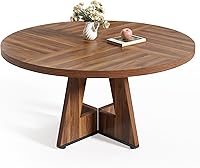
A round table's width is its diameter, so it has no corners but uses the same amount of floor space across the widest point. Compare round and rectangular dining tables if shape is part of your decision.
How wide is a table that seats six to eight?
A table around 31 to 32 in wide can still be labeled for six to eight people, but the length and serving habits matter. Check both dimensions and the maker's stated seating guidance before choosing.
The LITTLE TREE 71 Inch Solid Wood Dining Table measures 70.87 in long by 31.5 in wide and is described for 6 to 8 people. Its width is on the narrower side for shared dishes, so consider how much serving space you need in the center.
It has a solid wood tabletop and a trestle base with a bottom crossbar. Check chair placement against the base, and make sure the table's width works with the room and your usual dishes.
When is a wider dining table useful?
Choose a wider table when serving platters, multiple bowls, or centerpieces need a permanent place. A larger top can also suit meetings or meals where people use more than one dish at a time.
The Garvee 78.7 Inch Dining Table for 8 to 10 measures 78.74 in long by 35.43 in wide. That width offers more center space than the two narrower examples above, while its 4-legged metal frame and engineered wood top should be considered when checking chair positions.
The maker describes it for 8 to 10 people. Confirm that its larger footprint fits your dining area and leaves enough room for chairs to move.
How much room do you need around the table?
Include chair pull-out space and a clear path when you measure for table width. A wide tabletop can fit the room's dimensions on paper but still make it hard to walk behind seated guests.
Measure from the table edge to walls, cabinets, or other furniture on every side. Then account for the chair depth and the space needed to get in and out.
Our guide to how much space you need around a dining table explains how to check clearances. If the room is tight, a smaller top or a different shape may be easier to use.
How can you compare dining table widths before buying?
Write down your room's usable width, chair space, and serving needs before comparing table dimensions. This helps you decide whether to choose a compact top or leave space for larger dishes.
- Measure the room from wall to wall, including fixed cabinets and walkways.
- Mark the table footprint on the floor with tape.
- Place chairs at the taped edges and check how they move.
- Set out your usual plates and serving dishes to test tabletop depth.
- Check the width and length separately, along with leg placement.
Pick a table around 36 to 40 in wide if you want a flexible everyday surface. Choose a narrower table when floor space is the main limit, or a wider one when shared dishes need more room; then compare the table sizes and standard heights guide before you settle on dimensions.
Frequently asked questions
How wide should a dining table be for 6 people?
A width of about 36 to 40 in is a practical target for a table seating 6, with enough room for place settings and shared dishes. A table near 31 in wide can work if you keep serving pieces small, while a wider table needs more space around it for chairs and walking.
Is 30 inches wide enough for a dining table?
A 30 in wide dining table can work in a small room or for meals with compact place settings, but it leaves less room for serving dishes. Measure your plates, centerpieces, and any items that need to stay on the table before choosing a narrow design.
How much space should be between place settings?
Allow roughly 24 in of table edge per person so each setting has usable elbow room. The needed width from front to back also depends on plate size and whether serving dishes sit in the middle, so set out your usual dishes before deciding.
Does a wider dining table seat more people?
A wider table gives more room across its surface, but seating capacity depends more on the usable length and the shape of the base. Check chair placement and leg clearance, then compare your room dimensions with our guide to how many people a table seats.